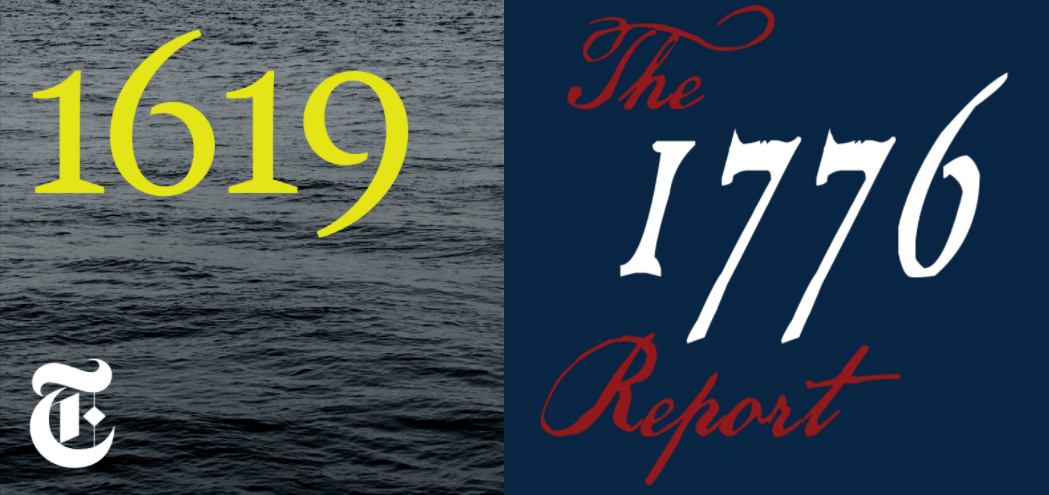
Note: Before I finished writing this article, the 1776 Commission was disbanded by a Joe Biden executive order. I feel it’s important to publish this anyway because I doubt this will be the last time there’s a battle over whose histories should be taught in the classroom.
Since the publishing of the landmark series of essays known as the 1619 Project a little over a year ago, an avalanche of both praise and criticism has manifested in its wake. Backlash from some of the biggest critics has rekindled a battle over what should and should not be taught in schools, with Sen. Tom Cotton (R) pushing to have it banned from classrooms after calling it “indoctrination.” Even former president Donald Trump joined in, threatening to defund schools that use it, and establishing the 1776 Advisory Commission to promote ‘patriotic education,’ which is language that could conjure up images of 20th century Fascist and Communist indoctrination programs. However, those who feel the 1619 Project should be required in schools and those who want it banned are missing the most important point: how history is taught is far more important than which historical texts are used to teach it. That is to say, students should be taught how to critically evaluate history from multiple perspectives, form their own opinions and interpretations, decide what those interpretations mean, and how those interpretations are relevant to their own lives. To be fair, both the 1619 Project and the 1776 Commission Report have some egregious errors in fact joined together with misleading and baseless claims.
The 1619 Project has come under serious fire from reputable historians, who point out the use of erroneous claims as it pertains to our nation’s founding and economic system. Among the most incendiary is Nikole Hannah-Jones’ opinion that the Revolution was fought to preserve the institution of slavery from a Great Britain that wanted to end it, which she passes off as “fact.”1 This statement in particular jumped out at me due to the irresponsibility of a journalist claiming her opinion as fact. Her justification for this claim is also weak — that there was a growing abolition movement Britain at the time. This ignores the fact that there was also a growing abolition movement in the 13 colonies, and many of the Founding Fathers were anti-slavery and started or joined abolition societies shortly after the war. In addition to that, eight states passed gradual abolition laws between 1777-1804, which makes for a lot of people who supposedly fought to preserve slavery only to do an about-face a few years later. Jones fails to provide any evidence that the institution of slavery was under imminent threat from Great Britain, who was profiting immensely off the transatlantic slave trade at the time and didn’t abolish slavery throughout its colonial empire until almost six decades after the adoption of the Declaration of Independence.
The 1776 Committee Report is even more flawed. Its writing is convoluted and sounds more like an opinionated, partisan diatribe than serious academic scholarship about history. One of the most creative, interpretive spins levied upon a historical time period is in regards to the Progressive Era. In the eyes of the writers, this was a time when the elites decided to forsake the nation’s founding ideals because industrialization had rendered them out outdated. Conveniently, nothing about the dangerous working conditions in factories, lack of safety and health codes that led to disasters such as the Triangle Shirtwaist Factory fire, or the Nadir of race relations is mentioned.2 Other egregious historical manipulations include the likening of the Pro-life movement of the last few decades to the Civil Rights and Gay Rights movements, and the connection the document attempts to make between present-day identity politics and the racial theories of John C. Calhoun, one of the 19th century’s staunchest defenders of slavery and the states’ right of nullification.
In the interest of the conversation at hand, the specific aforementioned historical fallacies are largely irrelevant and only highlighted to show examples of how the creators use and manipulate history to further their agenda. What’s more important is how history is taught, and whether or not students are, in fact, being indoctrinated. Indoctrination is any acceptance of a historical narrative without being afforded the opportunity or encouraged to question it using outside corroborating and contradictory sources. Unfortunately, most Social Studies education is still largely a process of indoctrination. Have you ever taken a history class structured around reading a textbook, answering questions about what was written in each section, and sitting through teacher-led lectures based on what’s written in the textbook? Did you then have to take a test or do a project where you regurgitated what the textbook said in some creative fashion? If that sounds familiar, you were indoctrinated. Admittedly, I, like many teachers, was guilty of teaching this way earlier on in my career.
In this respect, both sides of the debate are guilty of intent to indoctrinate, and this can be found in their statements about teaching and the educational resources provided, as the lessons are generally based around a wholesale acceptance of the arguments and interpretations contained therein. The 1619 Project comes complete with a curriculum guide for teachers to use, and the seminal lesson plan around Jones’ first essay contains a section of discussion questions that serve more to encourage a regurgitation and acceptance of what was written than anything resembling objective thought. One question asks students to go supply their own evidence for another one of Jones’ controversial claims — that the United States was founded as a “slavocracy”3 — leading students to accept this claim as truth. In fact, nowhere in this lesson plan or any others that I saw on the 1619 Project Curriculum asked students whether they agreed or disagreed with the essays’ claims — a huge missed learning opportunity. How great of a lesson would it make to have students research these two claims (that the Revolution was fought to preserve slavery and the nation was founded as a “slavocracy”) from multiple competing sources, the historical events surrounding them, and ask them to formulate an evidence-based argument? The students can then use their own perspectives on the the nation’s founding, that they themselves created through objective research, to evaluate historical and current events.
The stated goal of the 1776 Commission is to have educators who “convey a sense of enlightened patriotism that equips each generation with a knowledge of America’s founding principles, a deep reverence for their liberties, and a profound love of their country.” Hypocritically, the report continues by advocating for the rejection of “any curriculum that promotes one-sided partisan opinions, activist propaganda, or factional ideologies that demean America’s heritage, dishonor our heroes, or deny our principles.”4 I find the idea that students should be taught to blindly love their country rather troubling. How can you teach an African-American student at Jefferson Davis5 Middle School in Jacksonville, FL (who, according to Niche, has a only a 24% chance of being proficient in math and reading but a 69% chance of qualifying for free or reduced lunch) that he or she should automatically love their country when American history is riddled with slavery and acts of oppression towards black people? The answer is that you often can’t and definitely shouldn’t. Love of country is not something you can force upon someone who doesn’t want it. Instead, it’s something that develops over time, and in some cases, not at all, which is fine so long as the person is capable of keeping an open mind and considering multiple perspectives on issues. Having students decide for themselves what it means to be an American through research is far more engaging and endemic of a historian’s mindset than forcing it upon them.
Quite possibly the two most important tools for teaching history are the idea of historiography (the study of who writes history, how, for whom and what purpose, and what can that tell us about the society as a whole) and the use of inquiry with compelling, open-ended questions. The College, Career, and Civic Readiness (C3) Framework for teaching Social Studies provides an excellent basis for this type of teaching, which you can think of as similar to the Scientific Method, but for Social Studies. C3 uses an inquiry arc separated into four dimensions (development of compelling questions, using disciplinary lenses, evaluating sources and gathering evidence, and formulating arguments and taking informed, civic action) for examining historical and current event issues. While the 1776 Commission blasts teacher-led activism in the classroom, I believe this step is crucial in developing students into civically responsible citizens.6 I highly recommend reading Teaching What Really Happened: How to Avoid the Tyranny of Textbooks by James Loewen, as it provides great examples of how to have students question and critique historical narratives that partner well with the C3 methodology.
A good proving ground for this philosophy is the obligatory unit on Columbus “discovering” America. Not only does one’s perspective on Columbus have profound effects on their present-day paradigm, but I’ve seen teachers indoctrinate students from both sides of the spectrum;7 there are those who teach that Columbus was a great, praiseworthy, and infallible man, while others portray him as almost the equivalent of Adolf Hitler. Of course, these lessons are almost always followed by some assessment where the students have to regurgitate the teacher’s version of history.
Using the C3 framework, I’ve taken the approach of framing my unit on Columbus around the compelling question “What should Columbus’ legacy be?” Instead of force-feeding a specific version of history, the students are empowered to go and research for themselves the life and legacy of Columbus from a variety of viewpoints, and form steps to take civic action based on their findings (maybe remove statues, maybe erect more?). This is also a good time to go through different sources, primary and secondary, and evaluate author, purpose, audience, and credibility. One of my favorites to use in the classroom is another controversial book that has had its fair share of detractors: Howard Zinn’s famous polemic, A People’s History of the United States. I’m not going to sugarcoat just how poor this book is from an academic perspective. Zinn’s chicanery, which consists of fabricating quotes through the deceptive use of ellipses, carefully cherry-picking pieces of information out of context, distorting and misrepresenting sources’ intentions, including factual errors, failing to update claims in the face of newly available evidence, and heaping mountains of opinion and baseless claims passed off as hard truth, has yielded a version of American history far more conspiracy theory than reality, with the purpose of manipulating peoples’ paradigms against America and Capitalism.
But if the state of Arkansas or any of the other opponents of Zinn had actually banned him from the classroom, they would have robbed educators of a tremendous teachable moment: all historical writing should be critically questioned with an air of healthy skepticism. When portraying Columbus, Zinn melds largely fabricated quotes8 with information from the works of Bartolomé de las Casas, who was writing about events he witnessed decades after Columbus died. Having students dissect and critique these narratives and historical writing techniques through the use of primary sources and other secondary sources (the also-flawed Patriot’s History of the United States is a good juxtaposition both for its opposite slant and its own share of deceit) teaches them to think objectively, question sources, and understand that history is complicated and messy. Nuance matters, and there’s real value in simply knowing that there are multiple valid ways to interpret history. This alone could facilitate more understanding and respectful dialogue in the wake of hyper-partisanship.
The advocates of both the 1619 Project and the 1776 Commission have shown evidence that they lack the open-mindedness and capacity for understanding that could be taught by educating students in the aforementioned manner. In advocating the 1776 Commission, former president Trump called the 1619 Project ‘ideological poison,’ showing a complete ignorance of the historical and present-day conditions for many African-Americans that led to its creation. When criticisms were levied against the 1619 Project, Nikole Hannah-Jones often hid behind racially divisive tweets (which have since been deleted), calling her critics “old, white, male historians.” Many posts on Facebook attribute criticism of the 1619 Project to being against the teaching of slavery, such as one that accused Sen. Cotton (R) of “trying to legislate against the teaching of American history in regards to slavery because he believes it taints the story of America.” These dismissive statements show a complete disregard for the legitimacy of others’ viewpoints.
Whichever texts a teacher decides to use in the classroom, the emphasis should be placed on teaching students to be active participants in the study of history instead of passive sponges. Historiography, inquiry, and critical critique of narratives and sources should be at the center of all good history education, making it irrelevant whether the 1619 Project, 1776 Commission, or both are used in the classroom. With the lightning speed that suspicious headlines and memes are spread on social media, this level of diligence will coax people to dig, verify, and confirm information before sharing, eroding the walls of the echo chambers that entomb many users’ news feeds. Hopefully, with the right education, we can shape a more productive, open-minded future, one student at a time.
If you enjoyed this article, please follow me on X – @historyinfocus_net. I enjoy corresponding with other educators and those interested in history and economics. Also, you can reach me via the contact page. Please let me know what you thought of this article and how you heard about my website! Thank you!
Footnotes and citations
- From 1619 Project, page 18: “Conveniently left out of our founding mythology is the fact that one of the primary reasons the colonists decided to declare their independence from Britain was because they wanted to protect the institution of slavery.” This claim, which is largely false, has the potential to distort students’ beliefs about American history if they are taught to accept it without question.
- This refers to a time period of worsening race relations, spanning from the end of Reconstruction to the beginning of World War II.
- From 1619 Project, page 18: “It is not incidental that 10 of this nation’s first 12 presidents were enslavers, and some might argue that this nation was founded not as a democracy but as a slavocracy.” Jones attempts to shuck responsibility for this claim by using the terminology “some might argue.” I have never seen any reputable historian argue in favor of this position. The fact that so many early presidents were slaveholders was predicated on constitutional compromises made to slave states, without which, the south would not have joined the Union. In particular, the three-fifths compromise allowed the slave states to be over-represented by counting people who could not vote, did not pay tax, and were regarded little better than farm equipment in the determination of electoral votes. None of this means that the United States was founded to protect slavery, and historian Sean Wilentz argues in his book No Property in Man that the Constitution actually contained the seeds of the destruction of slavery. If you want to see a “slavocracy,” read the Constitution of the Confederate States of America and examine all of the codified protections for the institution (just search the term “slave”). Some examples include laws guaranteeing slavery in any new territories and forbidding any laws abolishing slavery.
- From 1776 Advisory Commission report, page 17.
- I chose Jefferson Davis for this example because he was the president of the Confederate States of America. You can insert any of countless schools named after Confederate leaders, including Stonewall Jackson High School (Manassas, VA), J.E.B. Stuart Middle School (Jacksonville, FL), and Forrest School (Chapel Hill, TN), named after a founding member of the Ku Klux Klan.
- Dimension Four of the C3 inquiry arc is dedicated to taking informed, civic action. However, teachers should be careful not to use students to advocate for their own causes. Any action taken should be led by the students after thoroughly researching an issue independent of the educator’s own personal beliefs. In fact, I believe that teachers should keep their political opinions at home, which is why I publish this blog anonymously. I am, however, often amused at my students’ attempts to guess who I’ve voted for in previous elections.
- I found this unit plan to be particularly dishonest in its one-sided presentation of Columbus, particularly its use of Zinn materials as fact (see below for more about this) and the claim that the engraving on page 14 represents what Columbus’ soldiers were doing (note the amateurism of copying directly off of a Wiki source). Thanks to other history enthusiasts who have done the research, I learned that the engraving in question was published in the 1598 version of Bartolome de las Casas’ “Brief History of the Destruction of the Indies,” which was written about events occurring decades after Columbus’ death. The alleged artist of the engraving (I haven’t conclusively confirmed it was de Bry, though it looks like his work) was born over 20 years after Columbus died, so his engravings in that regard are not primary sources. As they also point out, there seems to be no primary source evidence that Columbus ever did authorize the amputation of the hands of natives, despite the wide circulation and belief of this claim. Equally dishonest is the lack of any serious, objective scholarship about the fact. There are a few links to debate.org, where random people post their opinions, but that’s hardly reputable.
Update: since writing my article on Columbus and thoroughly researching the primary source record myself, I was unable to find any mention in primary or secondary sources of Columbus’s soldiers amputating the hands of natives prior to Hans Koning’s 1976. Absent evidence, it is likely Koning erroneously attributed these later crimes to Columbus himself and the claims have been repeated ever since. - This quote from Columbus’ diary is in the second substantive paragraph on the first substantive page of Howard Zinn’s A People’s History of the United States:
“They … brought us parrots and balls of cotton and spears and many other things, which they exchanged for the glass beads and hawks’ bells. They willingly traded everything they owned… . They were well-built, with good bodies and handsome features…. They do not bear arms, and do not know them, for I showed them a sword, they took it by the edge and cut themselves out of ignorance. They have no iron. Their spears are made of cane… . They would make fine servants…. With fifty men we could subjugate them all and make them do whatever we want.” [The emphasis is mine.]
This quote is highly misleading for what the ellipses leave out. Before the phrase “They would make fine servants,” (which actually differs in wording depending on the translation), the ellipses leave out a whole section about how the natives had wounds from other natives that came from the mainland to, as Columbus believed, take them as slaves. (Columbus’ diary, page 111) The ensuing ellipses leave out a full two pages, as the comment about subjugating them with fifty men was written two days later (Columbus’ diary, page 114), and has no relation to the previous statement. Regardless of your thoughts about Columbus, it’s hard to justify this level of dishonest history. Sadly, this quote has been widely circulated and repeated as gospel by countless sources, and Zinn’s book is full of deceitful historical writing practices that would not be acceptable in any of my students’ work.
 History in Focus